The Hidden Cost of Doing Business
How buying and selling agents could change the economics of B2B trade.
How would you feel if buying something meant spending three working days sorting out the details before you could even place the order?
Now imagine several sellers spending a full day each preparing an offer for you. Only one gets the sale.
Companies pay for a purchase twice: through the price of what they buy, and through the work required to reach the deal. Agent-to-agent commerce could radically reduce that second cost. We call it the B2B transaction cost.
Our interest in this problem comes from both sides. We've worked in B2B sales and, while building procurement software, interviewed procurement specialists about the friction they encounter. We want to understand what that hidden work costs and what companies could create if reaching a deal became dramatically easier.
What Makes A B2B Purchase Expensive?
Imagine your company needs a custom metal component for a machine. You have a drawing and a deadline. Now you need someone who can make it.
You contact several suppliers. One asks about the material. Another wants to understand how the part will be used. A third suggests changing the design. Days pass between answers.
Your engineer revises the drawing. You update the suppliers. Their offers arrive with different assumptions, prices, and delivery conditions. You need more answers before you can choose.
Meanwhile, each supplier is reviewing your request, checking feasibility, estimating costs, and preparing an offer. Every one is investing in an order it might never win.
One purchase can create several sales processes.
The coordination cost of that purchase includes the buyer's work and the combined effort across all suppliers evaluated.
How much work depends on what remains to be figured out. A laptop already has specifications and a price. A custom component needs technical clarification. A production line might begin with an outcome: “We need to produce twice as much in the same space.” Buyer and suppliers must help define the solution.
- SelectLaptop
- QuoteStandard motor
- ConfigureConveyor
- SpecifyCustom component
- Co-createProduction line
Moving toward co-creation can make each conversation more demanding. Exploring more suppliers multiplies the work. Some creates essential understanding; some repeats the same questions, explanations, and updates across companies.
An engineer catching a problem early creates value. The frustration is how much work goes into giving everyone the same information.
What Does One Purchase Cost Today?
We start with the hours people spend reaching an agreement:
Combined human effort = buyer hours + hours across all engaged suppliers.
A meeting with three people for one hour counts as three hours. Waiting overnight for a reply adds elapsed time, but only active work enters this calculation.
Research makes the workload tangible. Industrial cases reported 2–4 hours for a switchboard quotation, 20 hours for a spray-drying plant quotation, and 15–25 person-days for a cement plant budget quotation. These are historical cases with different scopes, before configuration-software improvements. They are not current averages for our purchase types. Industrial case study, 2010.
Counting competing suppliers matters too. A European Commission evaluation estimated about €28,000 across buyer and bidders for a typical public procurement procedure. Its scope included some post-award work and used 2009 labor costs, so it illustrates the combined burden rather than pricing a private-sector purchase. Commission, 2011.
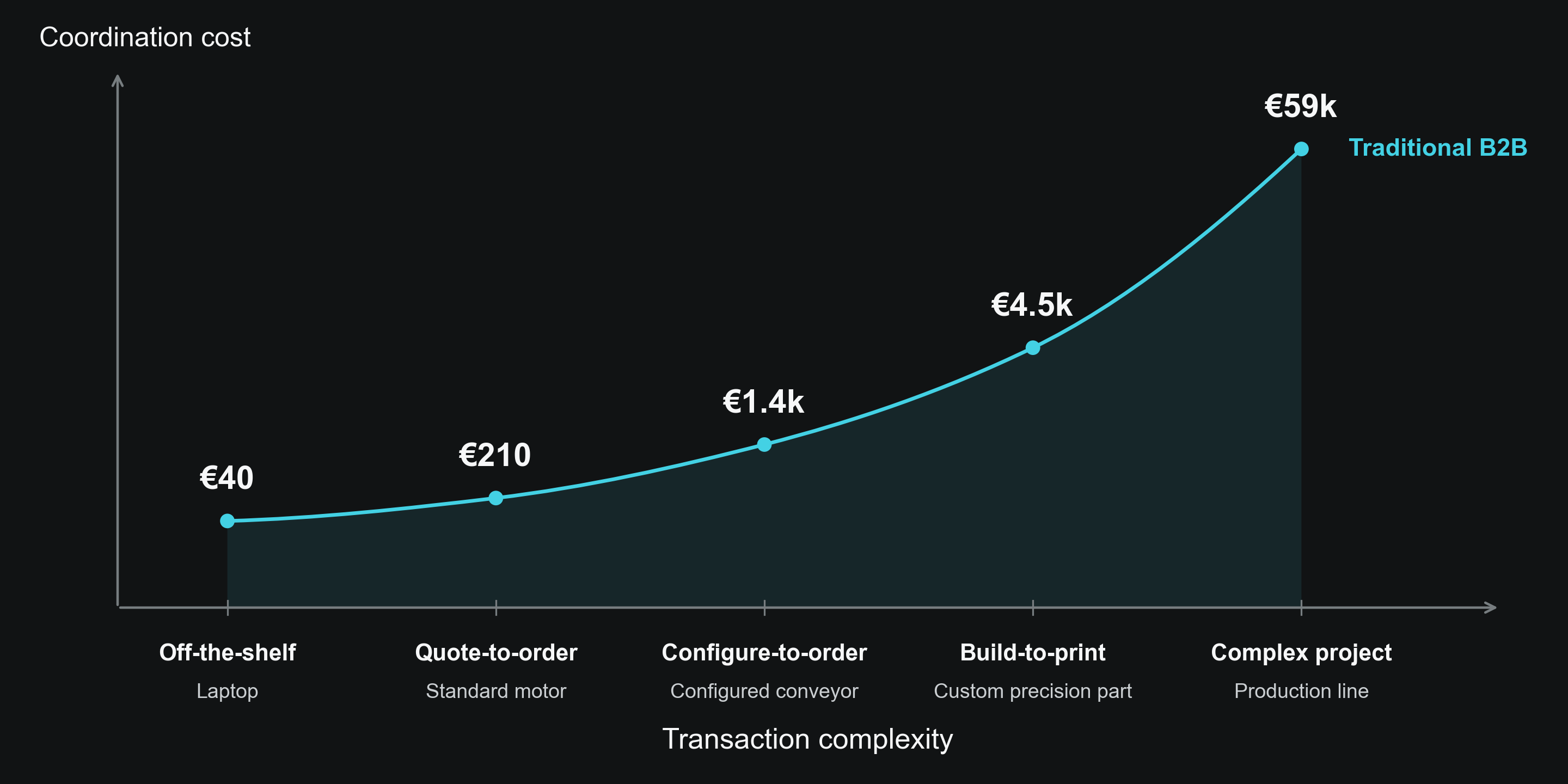
To explore the curve, consider five illustrative purchases at €50 per hour. That rate is an assumption. Denmark's 2025 average employer labor cost is €51.70. Eurostat, March 2026.
| Purchase | Buyer hours | Suppliers × average hours each | Combined labor cost |
|---|---|---|---|
| Laptop | 0.5 | 1 × 0.25 | €37.50 |
| Standard motor | 1.25 | 3 × 1 | €212.50 |
| Configured conveyor | 7.5 | 5 × 4 | €1,375 |
| Custom component | 25 | 8 × 8 | €4,450 |
| Production line | 180 | 20 × 50 | €59,000 |
Workloads and supplier counts are assumptions. Research supports the mechanism, not these inputs. Costs cover human work through placing the order, excluding production, delivery, and non-labor costs.
For the component, [25 buyer hours + (8 suppliers × 8 hours)] × €50 = €4,450. The production-line example averages supplier hours across early exits and finalists. We do not assume everyone does identical work.
The curve brings together two drivers: the depth of each conversation and the number of suppliers involved. They can also vary independently. A difficult purchase might involve one supplier; a straightforward request might reach many.
What Changes When Agents Talk To Each Other?
Imagine exploring twenty potential suppliers while spending your time on the questions that need your input.
Your company has a buying agent with access to your requirements, drawings, and priorities. Each supplier has a selling agent that understands the capabilities and information its company makes available.
The agents talk directly to each other.
One asks about material. Your agent answers from the specification. Another asks about quantities and delivery. Your agent responds, then asks which manufacturing processes the supplier can offer. Each answer leads to the next question, without a person opening an inbox or finding a document.
Across twenty suppliers, this could happen simultaneously.
Then someone asks how smooth the finished surface must be. Your engineer decides once. The buying agent updates the brief, and every relevant supplier conversation receives the approved requirement.
One human clarification could improve twenty supplier conversations.
That could change how widely a business explores the market. Comparing more suppliers would no longer require repeating every explanation yourself. Human attention could increasingly follow the decisions a purchase requires.
Your team returns to alternatives and decisions, with much of the information gathering already done. Suppliers that cannot meet the requirements can be identified before anyone develops an unsuitable proposal.
Agents could remove repeated work and waiting between replies. Engineering, validation, and approvals would still take time. People would develop solutions, weigh trade-offs, and make commitments. The ambition is to reach those decisions sooner, with better information.
We believe B2B could change as radically as shopping did when e-commerce opened up a selection far beyond the shelves of physical stores. Amazon's original shareholder letter.
E-commerce made a vast selection of products easy to explore. Agent-to-agent commerce could make a vast network of suppliers easy to talk to.
Early experiments offer a glimpse. In Anthropic's Project Deal, 69 employees had agents buy and sell personal items, reaching 186 agreements worth just over $4,000 in the run used for actual exchanges. Participants were broadly satisfied; most wanted to repeat the experience, and 46% of respondents said they would pay for such an agent. This was a small, subsidized employee marketplace. Anthropic, April 2026.
At P&G, an experiment with 791 professionals found that individuals using AI matched two-person teams without AI on product-innovation challenges. AI also helped combine technical and commercial perspectives. Dell’Acqua and colleagues, 2026.
Project Deal was a small employee marketplace; P&G studied product innovation. Together, they point to a powerful possibility: AI can help people find agreement and bring different expertise into a decision. We want to apply those capabilities to the far more complex work of reaching B2B deals.
How Large Could The Gap Become?
Agent-to-agent coordination could remove thousands of euros from the work behind a deal, and tens of thousands for a complex project. Our predictions draw on initial experience with Tradebird's MVP and exploration of the problem.
DTU and University of Southern Denmark research offers a precedent. In a study of 14 engineering companies, staff able to estimate the effects of product configurators reported averages of 78.8% less quotation work and 85.5% shorter quotation lead time. Those findings concern preparing offers; our prediction extends across the purchase. Haug, Hvam and Mortensen, 2011.
Let's return to the custom metal component. Our earlier example involved 25 hours for the buyer and 64 hours across eight suppliers. Together, that was 89 hours of work, costing €4,450.
With agents handling the repeated questions and information gathering, we predict the buyer could need two hours to clarify requirements, review the options, and decide.
Across all eight suppliers, we predict eight hours in total for technical checks, pricing, and discussions that need people. Both sides would also review the agents' work within those hours.
That would bring the combined human effort down from 89 hours to ten. At the same €50 per hour, those ten hours would cost €500. We then allow another €100 for running the agents and a share of setup and maintenance. That technology budget is an assumption, not a service quote.
€4,450 − (€500 human effort + €100 technology) = €3,850 potential gap.
That is about 87% less coordination cost. Here is the same logic across the curve:
| Purchase | Earlier labor cost | Predicted with agents | Potential gap |
|---|---|---|---|
| Laptop | €37.50 | €17.50 | €20 |
| Standard motor | €212.50 | €60 | €152.50 |
| Configured conveyor | €1,375 | €250 | €1,125 |
| Custom component | €4,450 | €600 | €3,850 |
| Production line | €59,000 | €5,000 | €54,000 |
Predictions assume 0.25, 1, 4.5, 10, and 90 remaining human hours at €50/hour, plus additional technology budgets of €5, €10, €25, €100, and €500 respectively. Existing costs common to both workflows are excluded.
For the production line, we predict 90 combined human hours instead of 1,180. With technology included, that brings coordination cost from €59,000 to €5,000. The potential gap is €54,000 behind one completed purchase.
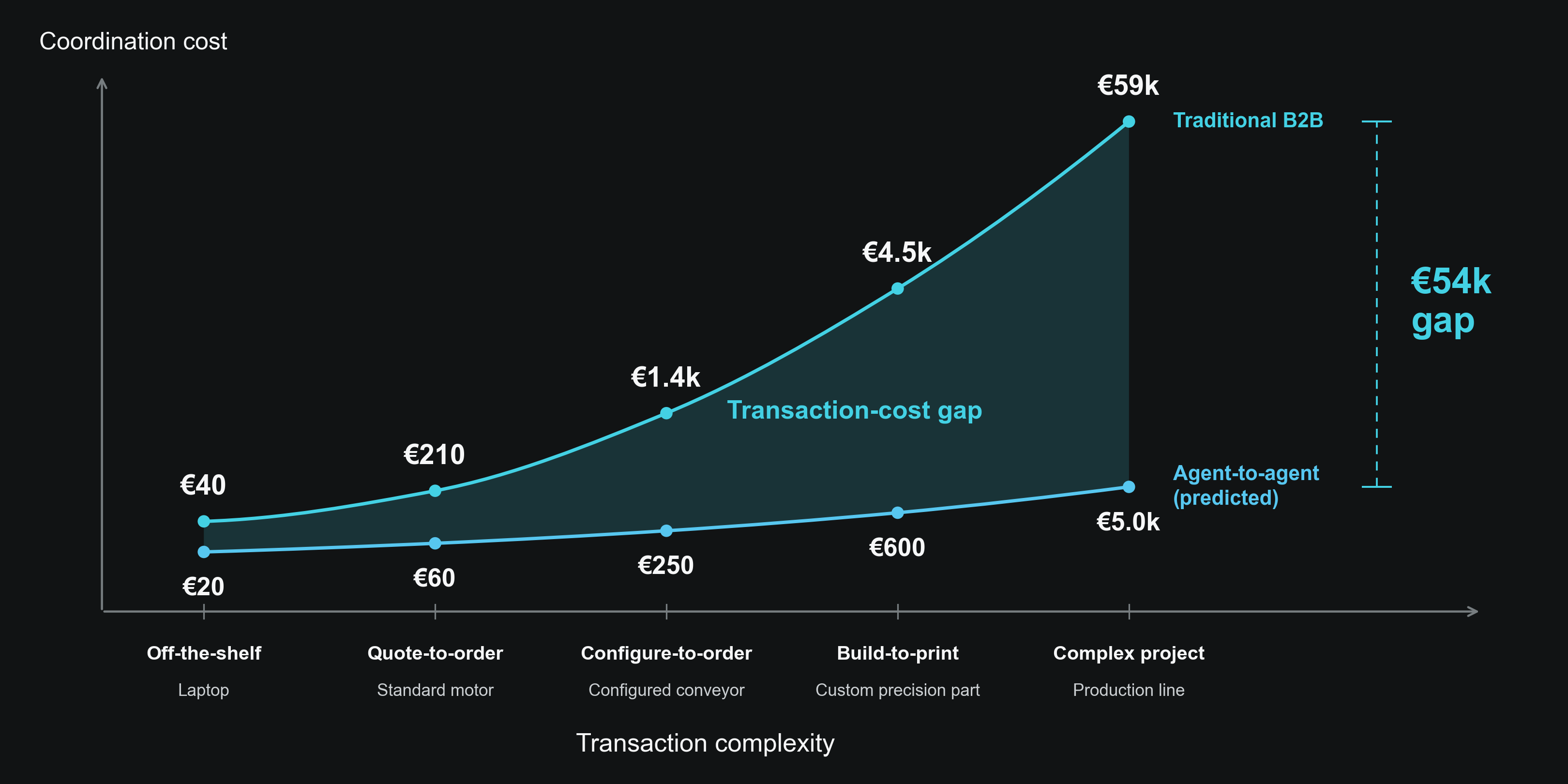
The largest euro opportunities emerge where demanding conversations repeat across suppliers. The value is shared across those companies as freed capacity; turning it into cash savings depends on how they use the time.
What Does That Mean At Economic Scale?
A €3,850 gap repeated a million times becomes €3.85 billion. How often might such purchases happen?
The backdrop is enormous: UNCTAD reports $28 trillion in business e-commerce sales across 45 economies in 2024, including businesses and consumers. UNCTAD, 2026.
For the EU, a Commission assessment cited a historical estimate of 15 billion business and government-related invoices annually. But one agreement can generate years of invoices. We need to count fresh buying decisions. Commission, 2023.
We focus on Quote → Configure → Specify → Co-create. Conventional e-commerce already handles standardized checkout. A new drawing or project with an existing supplier can qualify; routine reorders under unchanged agreements do not. Each buying need that reaches agreement counts once, including all its suppliers' effort.
Buying recurs frequently: 32% of European respondents in HKTDC's 2024–25 survey reported weekly sourcing. That includes routine orders, so it cannot establish the frequency we need. HKTDC, 2025.
We could not find a published EU-wide count. Instead, we explore one qualifying purchase per business per month, on average, including businesses with none. Eurostat's preliminary 2024 figures counted 33.5 million enterprises. Eurostat, 2025.
33.5 million businesses × 12 purchases a year = 402 million purchases.
We then assume a mix, classifying each purchase by the most demanding work it requires. The frequency and mix remain assumptions needing evidence.
| Purchase type | Assumed share | Annual purchases, rounded | Predicted gap each |
|---|---|---|---|
| Quote | 73.5% | 295 million | €152.50 |
| Configure | 20% | 80.4 million | €1,125 |
| Specify | 6% | 24.1 million | €3,850 |
| Co-create | 0.5% | 2.01 million | €54,000 |
Multiply each tier's purchases by its predicted gap. Custom purchases alone produce about €93 billion. Together, the scenario gives approximately €337 billion in potential annual coordination value.
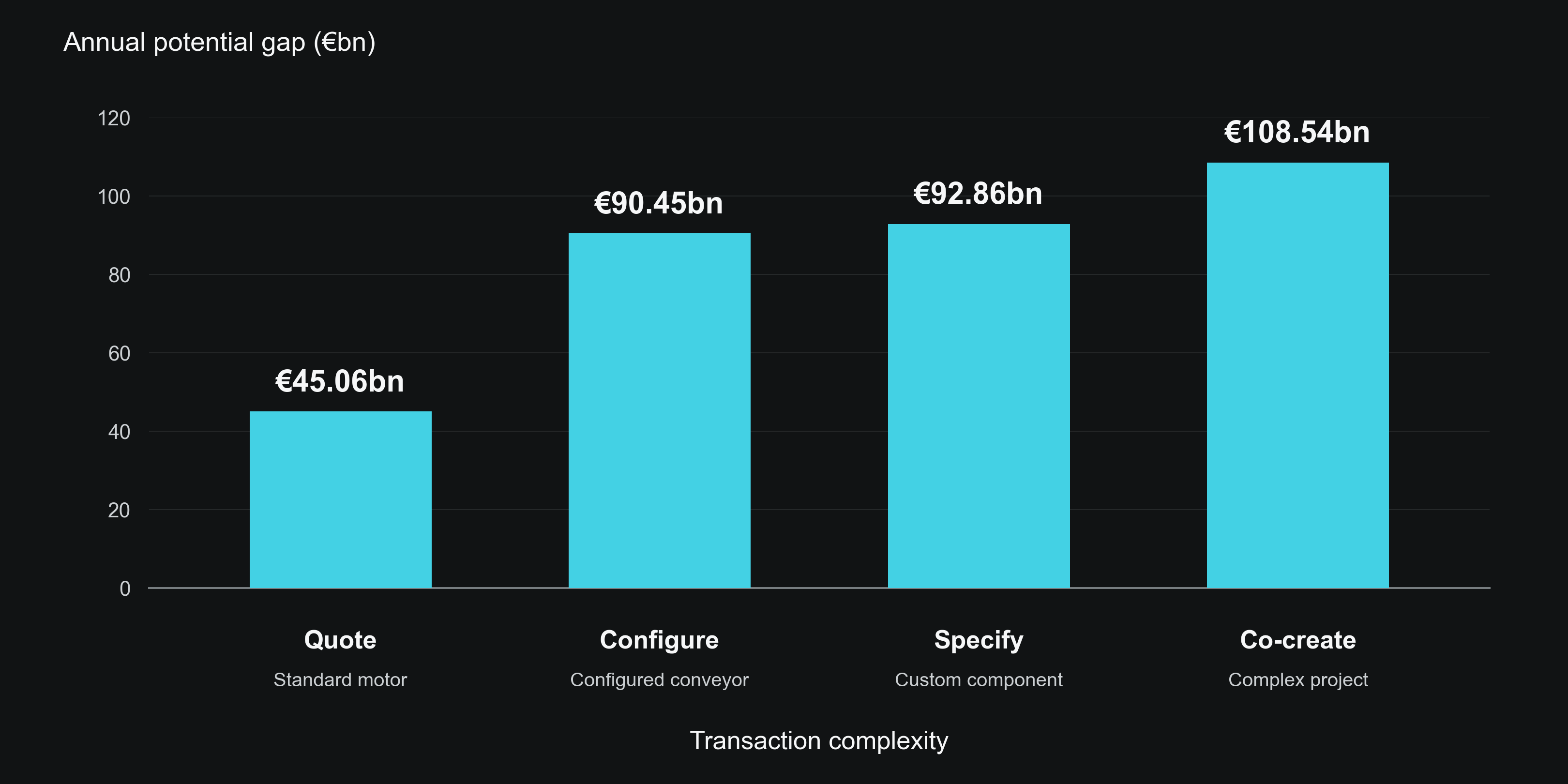
The exact number is uncertain. The point is the order of magnitude: even under a much more conservative frequency assumption, the hidden cost of coordinating B2B trade remains substantial.
Custom requirements and complex projects represent 6.5% of purchases but about 60% of the potential gap. The work behind each deal makes the difference.
For Tradebird, manufacturing offers a starting point: the EU had approximately 2.2 million manufacturing enterprises in 2023. Eurostat, December 2025 data. We begin with the Danish metal-supply and industrial-machinery ecosystem, where understanding supplier capabilities requires dialogue.
What Happens When Companies Can Talk Through Agents?
We imagine a world where every business has buying and selling agents transacting with one another. Businesses focus on delivering value. Agents handle the coordination.
Buying, selling, and customer relationships could connect to the world through that commercial layer. Even a small company could explore opportunities that once would have required a much larger team.
Picture a small manufacturer being discovered for a capability it has spent years perfecting. An engineer in another industry has a problem that expertise could solve. Their agents make the connection and work through the first questions. Two companies that might never have met now have a reason to create something together.
A buyer could explore beyond familiar suppliers. A specialist could win more deals because it fits the need, even without a large sales team. Ideas could travel further, across industries and borders, and find people able to bring them to life.
Those agents need a trusted marketplace to connect and trade, with clear rules for what they can share and do. Companies should be able to join without building the whole system themselves.
That is what we want to build with Tradebird, with people in control of the commitments they make and companies in control of the information their agents use and share.
E-commerce opened up a world of products we could buy.
We want to help open up a world of things companies could create together.